Famous paintings in the public domain and where to find them
Which famous paintings are out of copyright, why a museum photo of one can be free to use, and the open-access collections with high-resolution images.
Updated 2026-10-22
Most of the paintings people know by name are old enough to be out of copyright. Van Gogh's Irises, Hokusai's Great Wave, Vermeer's quiet interiors and Bruegel's Harvesters are free for anyone to copy, print, sell as a poster or turn into a jigsaw puzzle. The hard part is rarely the law. It is finding a sharp, high-resolution image that you are clearly allowed to use.
When a painting is in the public domain
Copyright does not last forever. In the European Union and the United Kingdom it usually ends 70 years after the end of the year the artist died, so the work of an artist who died in 1955 or earlier is free there today. In the United States, works published before 1978 are protected for up to 95 years from publication: on 1 January 2026, works from 1930 became free, so anything published before 1931 is now in the public domain there.
| Artist | Died | A famous work in the public domain |
|---|---|---|
| Pieter Bruegel the Elder | 1569 | The Harvesters (1565) |
| Johannes Vermeer | 1675 | Young Woman with a Water Pitcher (about 1662) |
| Katsushika Hokusai | 1849 | The Great Wave off Kanagawa (about 1830-32) |
| Utagawa Hiroshige | 1858 | Sudden Shower over Shin-Ohashi Bridge and Atake (1857) |
| Vincent van Gogh | 1890 | Irises (1890), Wheat Field with Cypresses (1889), The Starry Night (1889) |
| Georges Seurat | 1891 | Circus Sideshow (1887-88) |
| Edgar Degas | 1917 | The Dance Class (1874) |
Is a photo of an old painting free too?
A painting can be in the public domain while a museum still controls its own photograph of it. In the United States, a federal court held in Bridgeman Art Library v. Corel (1999) that a faithful photograph of a two-dimensional public-domain artwork is not original enough to have its own copyright. In the European Union, Article 14 of the 2019 copyright directive (2019/790) says the same for reproductions of public-domain visual art, unless the reproduction is itself original. Other countries differ, and a website's terms of use can still apply, so the simplest path is a museum that releases its images openly.
Where to find high-resolution images you can use
- The Metropolitan Museum of Art, Open Access: since 2017 The Met has released its images of public-domain works under CC0, for any use, including commercial, without asking. The object page marks which images are Open Access.
- The Cleveland Museum of Art, Open Access: public-domain works under CC0 since 2019, with a free public API.
- NASA: most NASA images are not subject to copyright in the United States. NASA asks to be credited as the source and that its material not be used in a way that implies endorsement.
- Wikimedia Commons: a huge library, including many museum images, but check the licence shown on each file.
This is general information, not legal advice. Copyright terms differ by country, and some works (for example, those first published long after the artist died) follow other rules. Check the licence on the image page before you use a picture commercially.
Which famous paintings make good jigsaw puzzles
Not every masterpiece plays well. Large areas of one colour, like a pale sky or a dark background, are slow and frustrating, and very dark paintings are hard to read on a phone screen. The best ones have detail everywhere and several clearly different areas of colour.
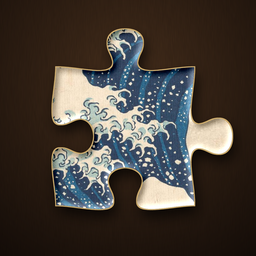
- Japanese woodblock prints, like Hokusai's Great Wave: strong outlines and flat areas of colour that are easy to sort.
- Van Gogh's late paintings, like Irises and Wheat Field with Cypresses: every brushstroke has a direction, which tells you where a piece belongs.
- Bruegel's Harvesters: dozens of small figures, so no two parts of the picture look alike.
- Impressionist scenes, like Degas's Dance Class: harder, because the colours blend softly. A good second or third puzzle.
Jigsaw Atelier is built on these collections. Every day it offers a new public-domain masterpiece as a puzzle, with its title, artist, date and museum shown like a gallery label. The Atelier Pass opens 20 themed rooms with more than 400 works from The Met and the Cleveland Museum of Art, plus a search of The Met's open-access collection. Puzzles go from 16 to 600 pieces, and every finished one hangs framed on your own gallery wall.
Read next
Questions
Is The Starry Night in the public domain?
Yes. Van Gogh painted it in 1889 and died in 1890, so the painting is out of copyright. It hangs at the Museum of Modern Art in New York, so check the terms of whichever photograph of it you use.
Is The Great Wave off Kanagawa in the public domain?
Yes. Hokusai died in 1849, and The Met offers its impression of the print (about 1830-32) as an Open Access image under CC0.
Can I sell prints or puzzles of public-domain paintings?
Generally yes: the painting itself is free. Use an image whose licence allows commercial use, such as CC0 images from The Met or the Cleveland Museum of Art, and do not suggest that a museum endorses your product.
Can I try Jigsaw Atelier for free?
Yes. Your first puzzle, today's masterpiece, is free. The Atelier Pass then starts with a 7-day free trial; cancel before it ends and you pay nothing.